
Product Introduction
Product Introduction
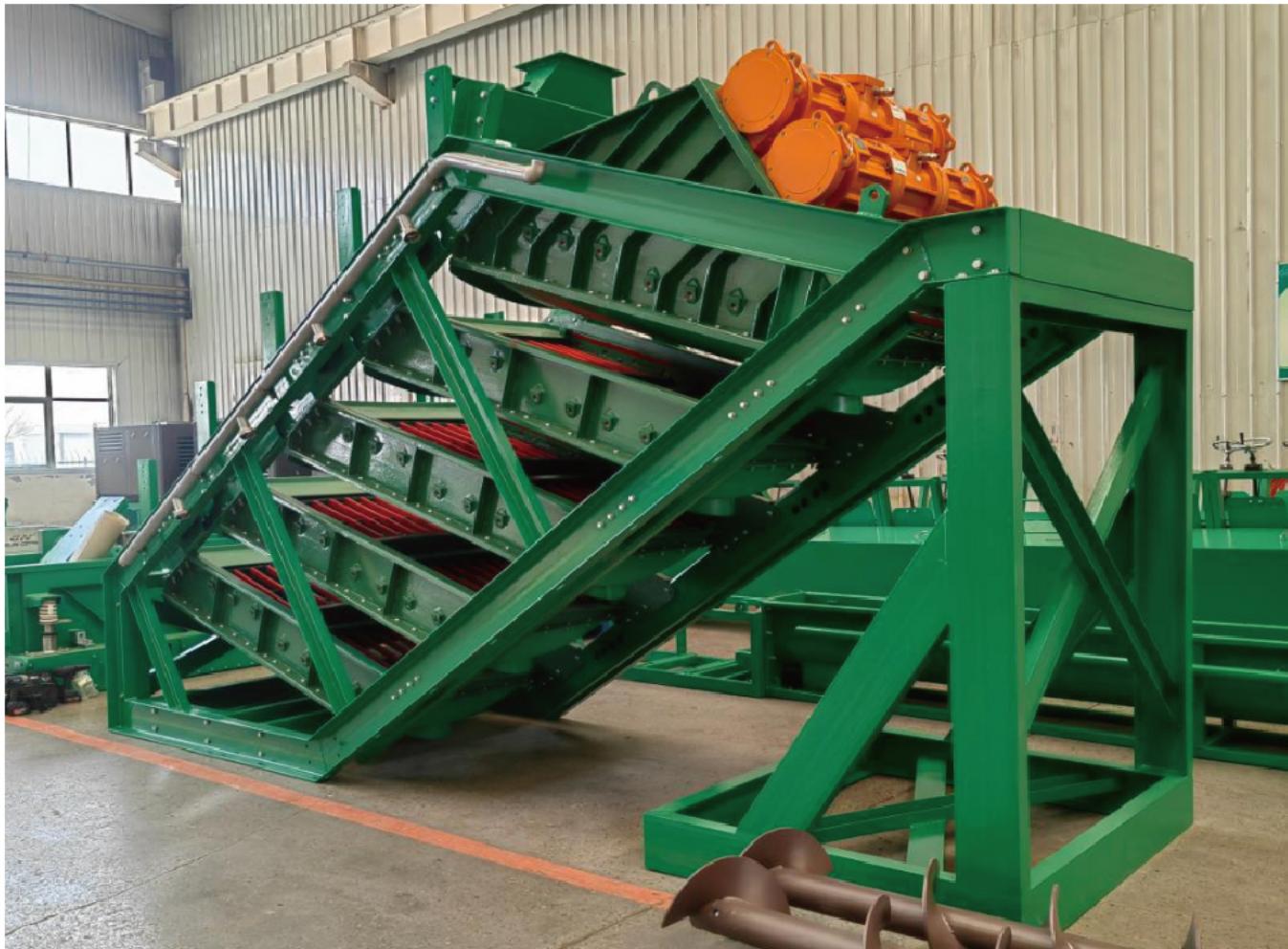
Laminated screen is the use of a unified vibration source to drive multi-layer screen box vibration equipment, is the use of independent screening system of the screen box up and down staggered laminated arrangement, each layer of screen surface to complete the feeding, screening operations, each layer of screen surface under the screen, the screen is collected and discharged.
The high frequency multilayer screen is an efficient fine grained material classification equipment which absorbs foreign advanced technology and digests and develops. The introduction and digestion of foreign advanced 5-layer linear vibration technology, large vibration amplitude, structure saving floor space. Two sets of cylindrical motors are configured to produce linear motion, and the suspended rubber spring system is suspended on the external support frame, which has uniform vibration force, low noise, low load, low power consumption and environmental protection. Wear-resistant materials such as ceramic, nat-resistant rubber plate and polyurethane are used to extend the service life of the equipment and reduce the amount of equipment maintenance. The equipment adopts quick-loading parts to realize the convenience of assembly and replacement of spare parts, which facilitates the on-site operation.
The laminated high-frequency vibration fine screen is driven by two electric vibrators moving in opposite directions to do linear motion of the screen frame, and the resultant force of the two electric vibrators acting on the screen frame passes through the center of gravity of the screen frame. Therefore, the excitation force of each point on the screen frame. The pulp is fed from the upper or lower part of the ore separator, evenly divided into multiple channels through the ore separator, and then into multiple ore feeders through the ore feed hose. The feeder spreads the pulp evenly over the end of the screen. The material on the screen surface is continuously subjected to high frequency and small amplitude vibration, and the continuous jump on the inclined screen surface causes the material to disperse, and the fine-grained material is called the product under the screen through the sieve hole in the process of smoothing, and the material larger than the sieve hole makes a continuous forward jump on the inclined screen surface, and finally jumps out of the screen to become the product on the screen
The high frequency multilayer screen is an efficient fine grained material classification equipment which absorbs foreign advanced technology and digests and develops. The introduction and digestion of foreign advanced 5-layer linear vibration technology, large vibration amplitude, structure saving floor space. Two sets of cylindrical motors are configured to produce linear motion, and the suspended rubber spring system is suspended on the external support frame, which has uniform vibration force, low noise, low load, low power consumption and environmental protection. Wear-resistant materials such as ceramic, nat-resistant rubber plate and polyurethane are used to extend the service life of the equipment and reduce the amount of equipment maintenance. The equipment adopts quick-loading parts to realize the convenience of assembly and replacement of spare parts, which facilitates the on-site operation.
The laminated high-frequency vibration fine screen is driven by two electric vibrators moving in opposite directions to do linear motion of the screen frame, and the resultant force of the two electric vibrators acting on the screen frame passes through the center of gravity of the screen frame. Therefore, the excitation force of each point on the screen frame. The pulp is fed from the upper or lower part of the ore separator, evenly divided into multiple channels through the ore separator, and then into multiple ore feeders through the ore feed hose. The feeder spreads the pulp evenly over the end of the screen. The material on the screen surface is continuously subjected to high frequency and small amplitude vibration, and the continuous jump on the inclined screen surface causes the material to disperse, and the fine-grained material is called the product under the screen through the sieve hole in the process of smoothing, and the material larger than the sieve hole makes a continuous forward jump on the inclined screen surface, and finally jumps out of the screen to become the product on the screen
Performance Parameter
| Model | Frequency (r/min) | Separation Size (mm) | Capacity (t/h) | Motor Power (kW) | Screen Area (m²) | Dimensions (L×W×H mm) | Remarks |
|---|---|---|---|---|---|---|---|
| DCS-12-1207Z | 1405 | 0.074~6.0 | 6~30 | 1.8 | 3.44 | 3790×1924×3279 | 2-Way Repulping |
| DCS-33-1007Z | 1405/1500 | 0.074~6.0 | 30~120 | 3.6 | 4.41 | 4050×1659×3715 | 3-Stack Repulping |
| DCS-44-1007Z | 1405/1500 | 0.074~6.0 | 40~150 | 4.5 | 5.88 | 5019×1659×3574 | 4-Stack Repulping |
| DCS-55-1007Z | 1405/1500 | 0.074~6.0 | 50~200 | 4.5 | 7.45 | 5640×1659×4427 | 5-Stack Repulping |
| DCS-55-1207Z | 1405/1500 | 0.074~6.0 | 80~220 | 4.8 | 8.88 | 5813×1803×4325 | |
| DCS-55-1207ZII | 1405 | 0.074~6.0 | 80~250 | 7.2 | 13.2 | 6747×1852×5541 | 5-Stack 2-Stage Repulping |